
What is Spastic Gait?
Spastic gait is a walking disorder caused by spastic paralysis of the limb muscles (in this case, the lower limb muscles) due to damage to the upper motor neurons. It is also sometimes called the scissors gait because both legs stiffen and the hips adduct.
Causative conditions include cerebrovascular disorders such as cerebral infarction and stroke, multiple sclerosis, and spinal cord injury.
A summary of spasticity and spasticity is available in a separate article.
When spasticity is present, the range of movement combinations becomes limited, making complex movements difficult.
Spasticity and Synergy
The combination of muscle activities during normal walking (muscle synergies) is thought to be composed of four or five distinct combinations. Muscles exhibiting spasticity fail to utilize some of these combinations effectively, resulting in a loss of smoothness in gait.
The figure below depicts the combinations of muscle activity (synergies) during walking, based on research by Francesco et al.
Each phase of walking is reproduced using four combinations: Module 1 through Module 4.
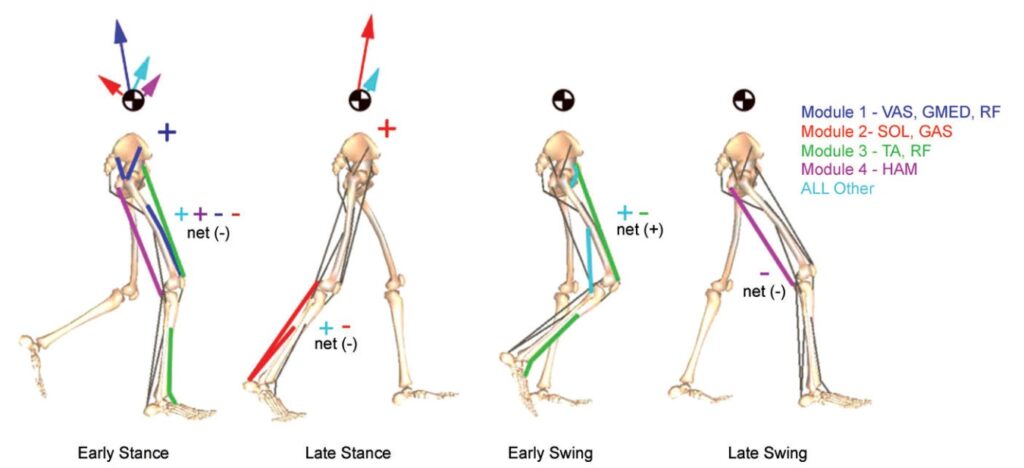
(Francesco Lacquaniti et al, 2012 Patterned control of human locomotion)
For example, when spasticity is observed in the triceps surae, it antagonizes the action of the tibialis anterior (TA) seen in Combination 3 (Module3), making dorsiflexion of the ankle difficult during early swing phase. This results in a swing-and-lift gait pattern where the foot is lifted high or swung forward in a sweeping motion. Furthermore, insufficient plantar flexion mobility from the soleus and gastrocnemius muscles (Module 2) makes it difficult to push off during the late stance phase.
Thus, spasticity is considered not only a matter of muscle stiffness or reduced flexibility but also an impediment within the movement itself.
Rehabilitation Introduction
This time, we introduce a rehabilitation session for gait disorders with spasticity following cervical myelopathy surgery. Please note this is merely one example for reference.
Overview of the rehabilitation scene
The video above shows the rehabilitation process, which roughly follows the steps below.
- The first half of the treatment addresses the ability of the core muscles to lift the pelvis and reduce mobility of the thoracic cage.
- Increasing supportive activity of the lower limbs helps to improve hypertonicity and shortening of the hip flexors.
- Attempts to improve accessory movements of the feet that can accept weight and the arch mechanism.
- Improves the supportive ability of the lower limbs while standing and facilitates a smooth transition from the support phase to the swing phase.
Conclusion
Here is a brief summary of one scene. Even if it is simply called spastic gait, the rehabilitation process will differ depending on the individual's physical function and compensatory activity (in the video, excessive tension in the trunk and hip joints, muscle shortening, etc.).
It is extremely important to assess each individual and develop a rehabilitation plan that takes into account the normal gait cycle.
The elements necessary for walking rehabilitation are summarized in the article below. Please take a look for a detailed explanation.